Common Mistakes to Avoid When Using Online Coding Assessment Tools
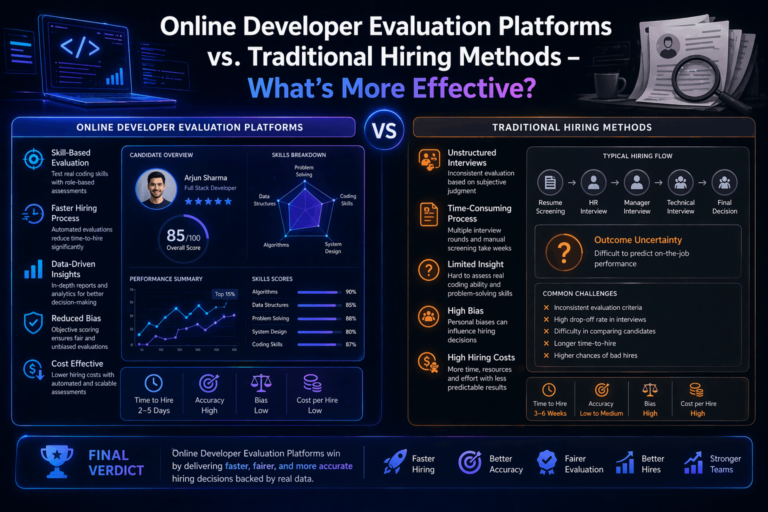
There are two parts to hiring rock star developer talent: Finding them through the right technologies, Effectively using those technologies to assess their skills. Despite the fact that many companies have begun using online coding assessment tools, surprisingly, most are unable to produce accurate results in their hiring process. This is not a result of problems with the online coding assessment tools but rather how the tool has been implemented.

Hiring in an automated fashion based solely on the results of an automated coding evaluation without a comprehensive hiring strategy may result in rejecting a qualified candidate or hiring a candidate who would not succeed as a member of your team. Therefore, it would benefit you to gain insights on the most common missteps that companies make when using coding assessments prior to scaling up your hiring procedure.
1. Treating Assessments as the Only Decision Factor
A major error for recruiters is depending solely upon test scores. While online coding assessment tools offer excellent knowledge about candidates, they do not provide a complete picture of their abilities.
A candidate’s:
- Ability to solve problems
- Communication abilities
- Ability to be flexible
Prove to be just as important as their scoring on assessments.
What to do instead:
Use coding tests as a filtering tool, not the final decision-maker. Combine them with interviews and real-world discussions.
2. Using Generic Tests for Every Role
Although every Developer position is different, very frequently an employer will use the same assessment for both
- Front End Developer
- Back End Engineer
- Full Stack Developer
This results in inconclusive results from the assessments and gives candidates a bad experience.
To promote a positive candidate experience with valid results, Adopt a customized assessment for the Developer using the following:
- Job Type
- Tech Stack Required
- Experience Level
A custom designed assessment will always yield more rewarding and measurable results than a generic assessment.
3. Ignoring Real-World Problem Scenarios
The majority of evaluations rely primarily on theoretical or puzzle-oriented inquiries in order to evaluate someone’s logic. Unfortunately, puzzles fail to represent actual work requirements.
The issue with this is:
Candidates who do well on puzzles will likely be poor performers when given actual development responsibilities.
To resolve this issue:
- Add real-world coding challenges like those you would use in an actual job.
- Create simulated situations based on what your employees encounter on a daily basis, so they can practice those scenarios.
- Conduct tests to evaluate both debugging and optimizing coding abilities.
4. Poor Candidate Experience
Highly skilled developers typically have several job opportunities available to them and may not want to spend an excessive amount of time going through a complicated and frustrating test (ex. over 3 hours). There is a variety of issues that can lead to talented developers dropping out of the hiring process, and some examples are:
- lengthy assessments
- unclear instruction
- slow testing platform
Conversely, the following are ways to improve the overall testing experience for the developer: limit assessment time (45-90 mins.), provide clear instructions to the developer, and create a simple user interface to ensure a smooth testing process. Providing a positive assessment experience will lead to higher rates of assessment completion and improve overall employer branding.
5. Not Analysing Test Data Properly
Several teams complete assessments, however most do not utilize the insights gathered from these assessments. Teams review the scores from their candidates but frequently overlook the more in-depth analytics behind these scores.
Modern technologies that provide assessments for coding skills contain the following information about how each candidate performed as part of their assessment:
- Codes quality analysis
- Time taken for each question
- Problem-solving patterns
Smart teams use all three of these analytics to help them:
- Identify candidates with the most potential
- Understand their strengths and weaknesses
- Make better hiring choices over time
6. Overlooking Cheating Prevention Measures
Remote recruiting makes it easier to assess potential employees, but creates an opportunity for people to cheat.
Not addressing this issue can lead to:
- Fraudulent Information
- Unqualified Employees
Solutions:
Use tools that will provide:
- Proctoring Services
- Plagiarism Checking Software
- Browser Activity Checking
These methods will help ensure that all assessments and evaluations are both fair and honest.
7. Setting Unrealistic Difficulty Levels
Some companies develop assessments that are:
- Too easy – everyone successfully completes the assessment
- Too difficult – nearly all candidates do not pass the assessment
Both cases can negatively affect a company’s ability to effectively hire talent. Here are recommendations to guide the development of assessments:
Ensure your assessments are challenging (not too high or low), are comprised of a range of difficultly levels, and match the difficulty of the question to the role of the job.
8. Lack of Clear Evaluation Criteria
If there is not a structured way to evaluate a candidate’s hire, the process will become inconsistent.
For example:
- One recruiter may be focused on speed.
- Another recruiter may be focused on code quality.
To remedy these inconsistencies, define:
- Scoring Benchmarks
- Evaluation Guidelines
- Minimum Qualification Thresholds
Results will improve with consistency.
9. Not Integrating with the Hiring Workflow
Some employers are applying coding tests separately and as an additional step beyond the standard recruiting process. This introduces:
- Delays
- Lack of communication
- No way to track candidates throughout the hiring process
Best practices are to connect the coding assessment platform to:
- Applicant Tracking Systems (ATS)
- Scheduling tools for interviews
- Processes for tracking candidates
10. Failing to Continuously Improve the Process
Hiring processes should be continuously improved over time and not just done once. Many organizations will have long-standing test structures in place that they keep using without updating them.
The reason this is important: Technology is constantly changing and therefore the skills required as a result of that technology also change.
What to do:
- Continually update test questions
- Analyse hiring results
- Optimize assessments based on data from previous performances.
Final Thoughts
When used wisely, online coding assessment tools can greatly enhance technical recruiting. By avoiding the most frequent blunders of leveraging these tools, you will have access to more precise results, enhance candidate experiences, and ultimately create improved hiring decisions.
For additional information on how to utilize these tools, check out our entire guide on online assessment tools.
Tools such as Codexpro provide companies with the means to create intuitive and dependable hiring processes via custom assessments and evaluations both in real time and with in-depth analytics. If employed properly, they can be a tremendous ally in determining the best technical candidates.