
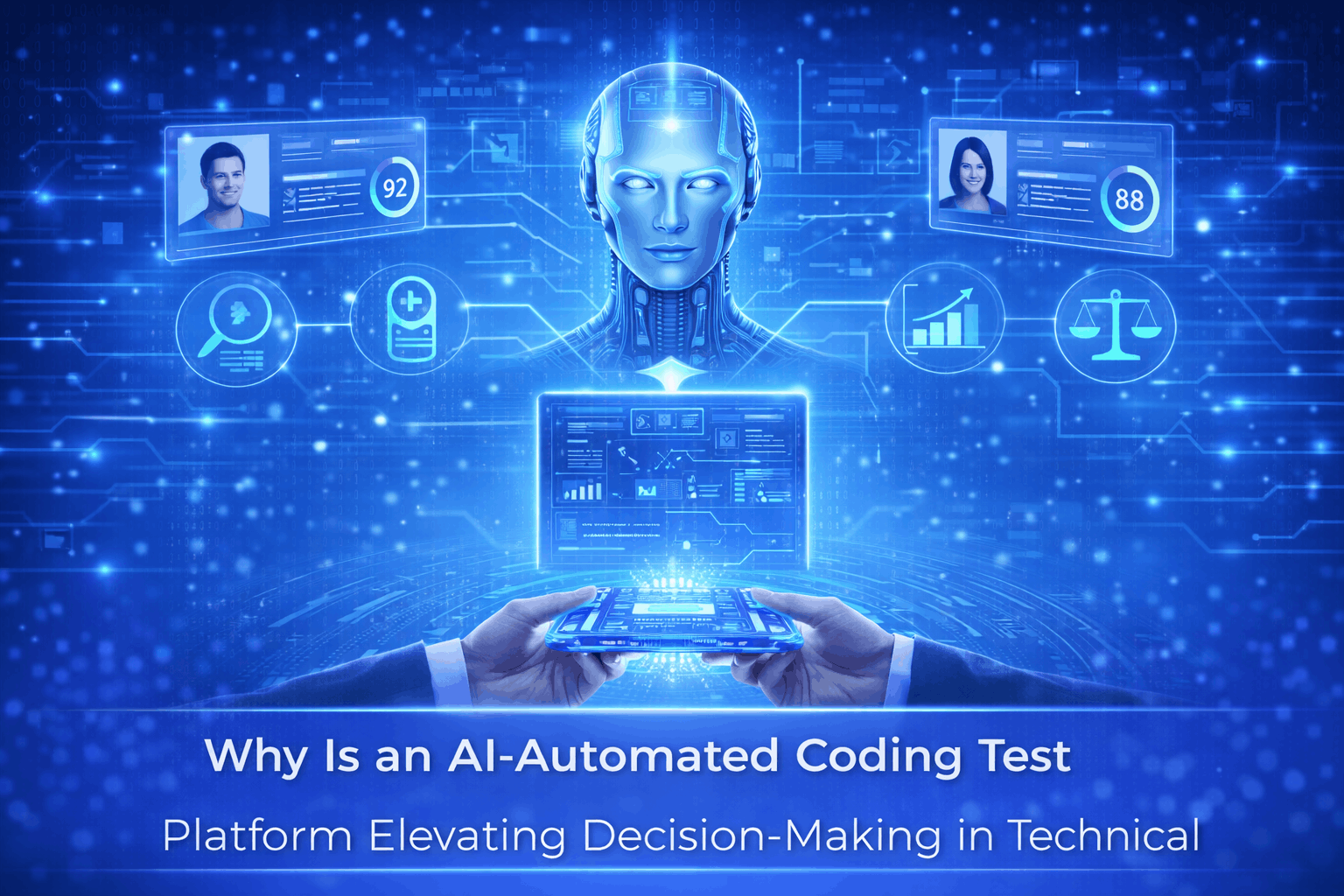
How Is an AI-Automated Coding Test Platform Elevating Decision-Making in Technical Hiring?

AI-Automated Coding Test Platform

Technical hiring has evolved from its traditional methods, which relied on resume shortlisting and informal interviews. HR and recruitment professionals now face the responsibility to achieve fast yet fair and easily defensible hiring outcomes, which apply specifically to positions that directly affect product quality and business success. The AI-Automated coding test platform operates as a structured decision system that provides technical recruitment processes with clear and consistent elements that deliver quantifiable advantages.
AI-Automated Coding Test Platform

The Shift from Intuition-based Hiring to Performance-based Evaluation

Traditional hiring depends on easily available signals like education, experience, or past employers, yet these rarely predict real on-the-job performance. The complexity of technical roles has rendered work performance indicators less effective as assessment tools. Modern hiring requires proof through performance.

The process of automated coding assessments tests actual problem-solving skills, which help HR departments decrease initial assessment doubts while developing better quality and more precise candidate lists.

Why are resumes and interviews now untrustworthy methods to assess coding skills?

Resumes show background, not real execution, while interviews often reward communication over technical depth. This hiring process creates risk because strong coders will get missed, and confident speakers will receive too much value.

The AI-Automated coding test platform solves this problem by assessing actual coding skills, which lets recruiters use direct job-related evidence to make their initial decisions instead of relying on their personal feelings.

An advanced assessment that goes beyond right or wrong answers

Basic coding tests check whether an answer works, but advanced platforms assess how solutions are developed. The process evaluates how well candidates break down problems, organise their code, and maintain efficiency while working under specific restrictions.

For HR teams, this depth converts complex technical performance into clear, standardised reports that highlight strengths, gaps, and overall role fit without reviewing raw code.

How does this reduce dependency on engineering teams?

Technical hiring processes require initial screening to be performed by engineering teams, which creates delays in recruitment because it takes away senior developers from their essential responsibilities.

The AI-Automated coding test platform uses automated testing for its initial assessments, which enables HR departments to conduct widespread candidate evaluation while engineers participate in detailed evaluation meetings that maintain evaluation standards.

Consistency as a foundation for fair and scalable hiring

The process of scaling hiring operations faces challenges because different assessment methods and interviewer assessments lead to employment bias problems, which create additional risk factors. Standardised coding assessments create a single evaluation framework across roles and locations, which ensures every candidate is judged by the same criteria to improve hiring decision fairness, compliance, and confidence.

Can standardised evaluation actually reduce bias?

The bias problem begins when interviewers make decisions based on their personal preference for particular backgrounds and communication methods. The AI-Automated coding test platform prevents this risk by conducting performance assessments. The evaluation of candidates shows their problem-solving abilities, which enables fair hiring practices that include all candidates without compromising technical requirements.

Supporting remote and distributed hiring models

Remote work has widened talent access but made assessments harder to manage across time zones, slowing hiring and increasing drop-offs. Automated coding tests enable asynchronous evaluation, allowing candidates to test on their schedule while recruiters review standardised results later.

The assessment process maintains its quality because the system enables candidates to participate from anywhere in the world while improving their overall experience.

Turning assessment data into long-term hiring intelligence

Hiring decisions should not exist in isolation. Assessment data shows continuous patterns that HR teams use to develop role requirements, benchmarks, and performance expectations. The AI-Automated coding test platform provides performance insights that help hiring managers work together better while making their final decisions with increased confidence.

The system selects candidates based on actual job performance, which reduces costs associated with hiring mistakes that occur over time.

Preparing hiring processes for evolving skill demands

The speed of technological progress exceeds the pace of traditional recruitment methods. The skills required for today will undergo changes within the next few months. Static assessments quickly become outdated. The advanced coding assessment platforms enable organisations to modify their evaluation standards according to their evolving business requirements.

The hiring process maintains its connection to modern technical standards through the combination of role-specific challenges and newly developed skill assessments.

Conclusion

Technical hiring now demands evidence, speed, and consistency. HR leaders can no longer rely on resumes and intuition to assess complex coding roles. The AI-Automated coding test platform provides a solution to this problem through its ability to conduct performance assessments, which deliver unbiased results across multiple tests. Companies now have a way to make their technical hiring process more efficient through CodexPro, which offers global recruitment solutions that enable better hiring decisions.
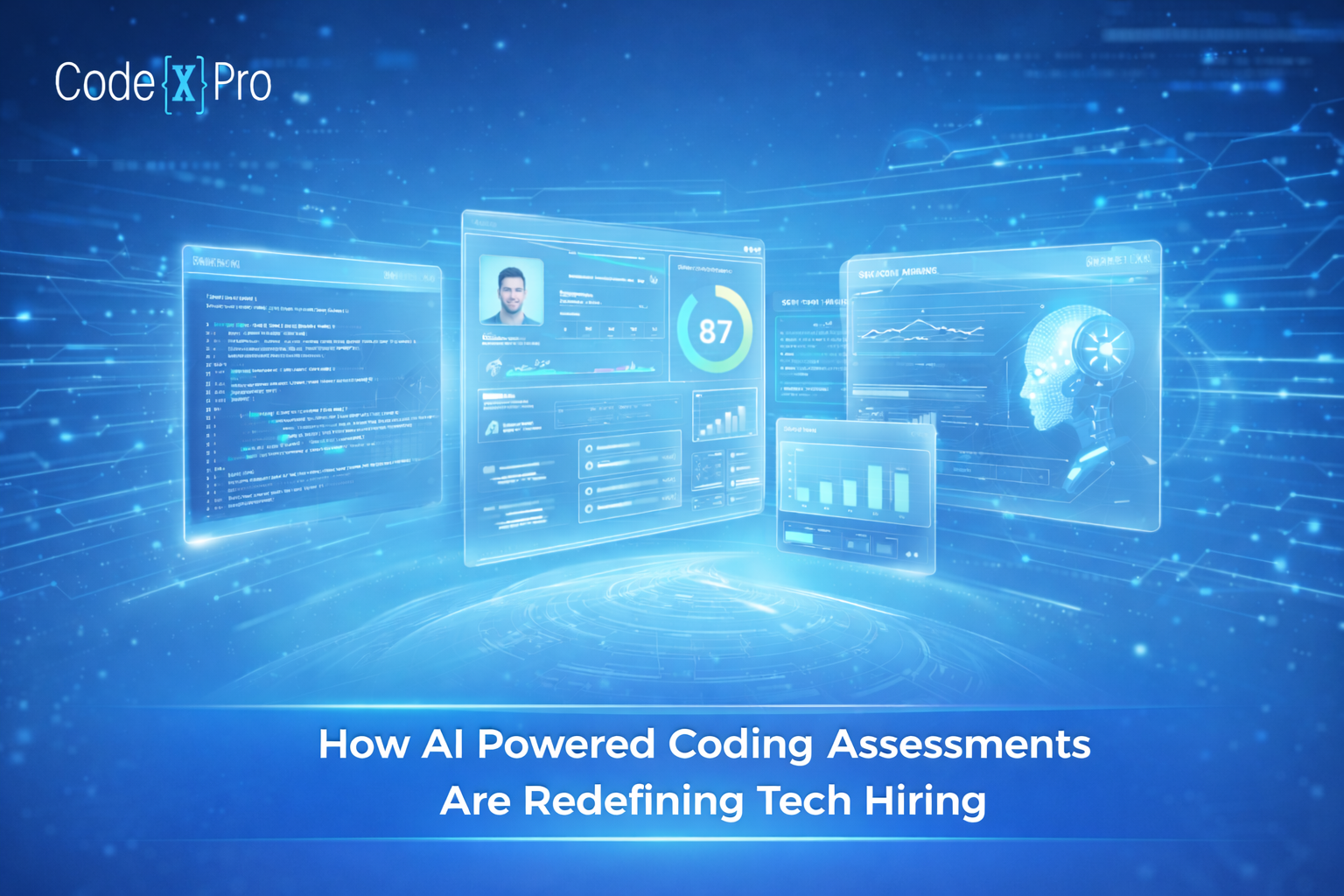
How AI-Powered Coding Assessments Are Redefining Tech Hiring?

AI-Powered Coding Assessments

Recruiting talented developers is no longer a matter of resume scanning or posing clever interview questions. Most organisations find difficulties in the prolonged hiring process, irregular assessment and applicants who seem to appear good on paper and do not deliver in the workplace. To solve this specific issue, AI-powered coding assessments can assist the teams in judging actual coding skills at a young age and in an objective manner. The organisations will be able to make sure decisions, supported by performance data, rather than speculate.

AI-Powered Coding Assessments

What Are AI-Powered Coding Assessments?

Fundamentally, AI-powered coding assessments act as intelligent tools that evaluate how developers think, reason, and perform while writing code in real-world scenarios. These systems automatically analyse solutions using artificial intelligence, instead of using fixed questions or going through them manually.

They evaluate how candidates approach problems, write clean and efficient code, and handle edge cases. This approach provides a far more accurate picture of a candidate’s real-world readiness, which traditional tests often fail to capture.

The Real Challenges in Modern Developer Hiring

The growing demand for developers has made the technical hiring process more complex. Recruiters have to deal with high numbers of applicants, and engineering groups do not have time to sift through applications. Resume screening eliminates good candidates, and interviews are too based on the opinion of the interviewer.

Simple coding tests are another frustrating factor. Several concentrate on perplexities that are not applicable in day-to-day development work. This loophole results in the squandering of resources, delays in making decisions, and expensive staffing errors that have a long-term impact on productivity.

Why Intelligent Assessments Deliver Better Results?

Accuracy is one of the key factors behind the use of AI-powered coding assessments by companies. AI scores all submissions based on similar criteria, and that removes the subjectivity that accompanies manual scoring. All the candidates are evaluated against equal technical standards.

Results are not limited to pass or fail results. Comprehensive feedback gives an understanding of strengths, weaknesses and patterns of solving problems. This enables the hiring managers to know not only whether a candidate has the ability to code, but also how he or she codes.

Faster Hiring Without Compromising Standards

In competitive hiring markets, speed is very important. Prolonged selection processes usually translate to the loss of the best candidates to companies that are faster in their operations. Automated evaluation software is useful in that it saves a lot of time in terms of reviewing because it offers immediate feedback and formal reports.

Recruiters are in a position to weed out qualified candidates in a short time, and engineers are saving time to read unsuitable submissions. The process becomes quick without reducing technical expectations and quality.

Building Fair and Objective Hiring Processes

Discrimination, however unintended, has an influence on the hiring process. The way, education background, or familiarity during interviews can be a factor. Smart assessment systems are simply concerned with performance, which minimizes subjectivity.

Standardization of evaluation criteria creates a fairer employment procedure for the firms. This will help in diversity and inclusion, and at the same time give all candidates an equal chance to prove proficiency.

Improving the Candidate Experience

In technical hiring, experience with candidates is not always taken into account. Frustration and drop-offs are due to long tests, incomprehensible instructions and delays in feedback. Good coding tests are those based on real problems that are practical in the job.

Developers like to be tested on the work they are doing and not on deceptive questions. A less cumbersome and respectful procedure enhances participation and builds the reputation of the employer within the developer circle.

Scaling Hiring as Teams and Needs Grow

With the growth in organisations, more people are needed to work in various positions and places. The process of manual review is unable to maintain the pace of increased volumes. Smart grading systems are scalable, and they can deal with hundreds of applicants without degrading.

This scalability is particularly useful to both startups and large businesses that are growing fast. They are able to keep the quality of hiring and expand quickly.

Preparing for the Future of Technical Recruitment

The future of recruitment is one that is based on data. Organisations that are purely untenable on resumes and interviews are on the losing end amidst increasing competition for talent. Smart evaluation techniques aid in organisations being dynamic to shifting expectations and demands in the workforce.

Through AI-Powered Coding Assessments, teams can also on the actual capability, minimize risks, and create a more robust engineering base that can drive future growth.

Conclusion

Hiring should be done in an efficient, fair and skill-based manner. When the companies abandon the old-fashioned approach and implement intelligent assessment tools, the results of the hiring process get better on all levels. Such solutions as AI-powered coding assessments can assist organisations in streamlining their recruitment strategy and making informed decisions. To find out more about how to create a better technical team by making smarter assessments, go to CodexPro.