
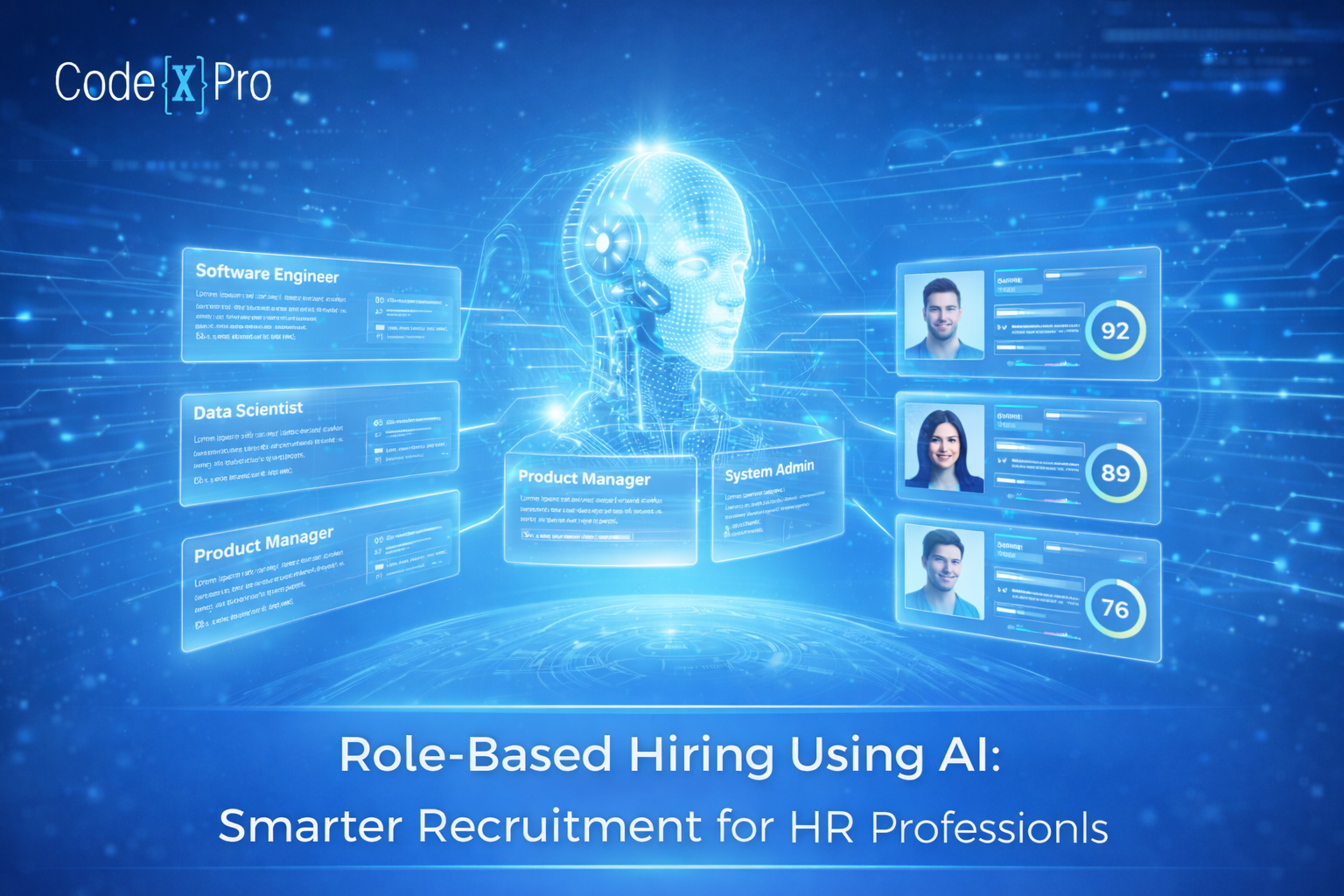
The aspect of recruiting has never been an easy one when running a business. You as HR professionals always find yourself juggling between speed in finding a suitable candidate to fill a position, accuracy and quality in the process. The stakes are great: one erroneous recruitment could lead to the loss of thousands of productivity, lost deadlines, and cultural misunderstandings.
During the last couple of years, AI has begun to actually change something, but not to kill HR, but to assist the HR to make smarter, faster and more objective hiring decisions. Role-based hiring with the help of AI is one of the most thrilling applications.
What exactly is Role-Based Hiring?
Role-based recruiting is not simply about recruiting a job. It is about determining the unique skills, behaviors, competencies, the job really requires and acquiring individuals that fit that profile.
Conventional recruitment frequently uses the resume, LinkedIn or in the case of interviewing, gut instinct. Although these practices are effective to some degree, they often rely on subjective judgments, which introduces bias and inconsistency. With an appropriate approach to AI, the process can become not guesswork but rather an evidence-based, accurate system.
For example is Codexpro, which assists companies in creating specific assessments depending on every position, be it the software developer, data analyst, or UX designer. Instead of using generic tests, AI ensures that candidates are assessed on the specific skills the job requires.
Why HR Teams Should Consider AI for Role-Based Hiring
What would happen if you had to look through hundreds of resumes one by one or even one interview after another to find out that most of the applications are not able to fit the requirements of the position. It is tiring and it does not need to be so. AI can help by:
Automation of the Screening: AI can process resumes and application forms and select a shortlist of candidates who fit the technical and behavioral requirements of a job precisely.
Minimizing Bias: AI can reduce unconscious bias, which can affect the judgment of a human, by concentrating on skills and performance data.
Saving Time and Money: HR teams can now obtain actionable insights in hours rather than spending weeks in the course of preliminary screening and evaluations.
Better Quality of Hires: This precise alignment between candidates and roles reduces turnover and improves overall team performance.
How AI Actually Works in Role-Based Hiring
The AI is beautiful because it does not imitate the human decision making, but makes it better. Here’s how it typically works:
Role Analysis: AI determines the main competencies and skills needed in the job.
Assessment Generation: platforms such as CodexPro create tests and problems specific to the job, or coding tests that test developers or logic tests that test analysts, or specific situational judgment tests that test managers.
Candidate Scoring: AI is an objective way of evaluating the candidates, where strengths, weaknesses and their appropriateness in the position are described.
Insight reports: Actionable feedback, rather than merely the scores, is delivered to the HR making it easier to make decisions fast.
Other sophisticated platforms even spot malpractice during evaluation hence giving accurate and valid results.
Real-World Benefits for Recruitment Teams
The following are the things that the HR teams should anticipate by implementing AI in role-based hiring:
More Rapid Decisions: Reduce the screening weeks to days.
Greater Fitment of Talents: There is more precise matching of candidates to their roles and this lowers turnover at the initial stages.
Regular testing: All of the candidates are evaluated by the same set of criteria, removing subjective differences.
Improved Candidate Experience: The hiring process will be transparent and professional because of automated feedback and clear evaluation reports.
FAQs
Q1: Will AI replace human recruiters?
Not at all. AI is a tool to enhance human judgment, not replace it. It handles repetitive tasks and provides insights, but the final hiring decisions, including cultural fit, still rest with HR professionals.
Q2: How can AI prevent hiring bias?
AI evaluates candidates based on objective criteria like skills and assessment performance rather than gender, age, or background. Properly trained AI reduces the influence of unconscious bias in hiring.
Q3: Can AI handle complex roles like senior managers or domain experts?
Yes. Modern AI platforms allow you to define role-specific competencies, ensuring even complex or leadership roles are assessed accurately.
Q4: How does AI make campus recruitment more effective?
AI enables bulk testing and assessment, instantly identifying top performers. This reduces administrative overhead and ensures the best talent is discovered efficiently.
Q5: Are candidates intimidated by AI assessments?
Not when the platform is well-designed. Clear instructions, user-friendly interfaces, and instant feedback help candidates feel confident and engaged.
The Future of Role-Based Hiring
Role-based hiring based on AI is no longer a futuristic concept, but it is reality today. HR professionals that adopt these tools will achieve improved hiring results, accelerated operations, and enhanced talent-business alignment.
This approach does not replace human judgment; instead, it enhances it with data-driven intelligence, allowing HR teams to focus on strategy, culture, and growth.
Platforms such as Codexpro demonstrate how AI in recruitment can bridge the gap between speed and quality, giving HR teams a competitive advantage in the talent market.
Conclusion:
It is not an easy task to find the right individual to the right position and AI makes it possible. Using role-based hiring enables HR professionals to minimize their guesses and increase their candidates satisfaction, as well as concentrate on what is really important, and that is establishing quality and competent teams that make the business successful.
Are You Ready to Hire Smarter, Not Harder?
When you are fed up with guessing a candidate in being right about a position, it is time to reconsider the process of hiring. Hiring through the use of AI provides role-based hiring that offers HR teams the transparency, speed, and confidence to make better decisions without the loss of the human touch.
Tools like Codexpro help recruitment teams deliver job-relevant assessments, actionable insights, and scalable hiring processes that work in real-world scenarios.
Discover the ways in which Codexpro can assist you in making more precise and accurate assessments of candidates, minimize the risks of hiring and develop stronger teams, position by position.
Begin to make hiring choices, supported by skill, rather than presumption.