In the modern world of high competition, it is becoming more complicated to hire the best tech talent. Organizations are also not competing against each other to get skilled developers; they are also trying to find those candidates that are capable of performing in real life situations. Nevertheless, conventional methods of hiring are apt to fail miserably when it comes to the technical aptitude quantification. Hence, a significant proportion of firms suffer expensive recruitment errors, time-consuming recruitment, and unequal assessment criteria. It is here that AI Powered Coding Assessments comes in as a game changer, and the hiring ecosystem is quickly changing to be more accurate, more efficient, and reliable.
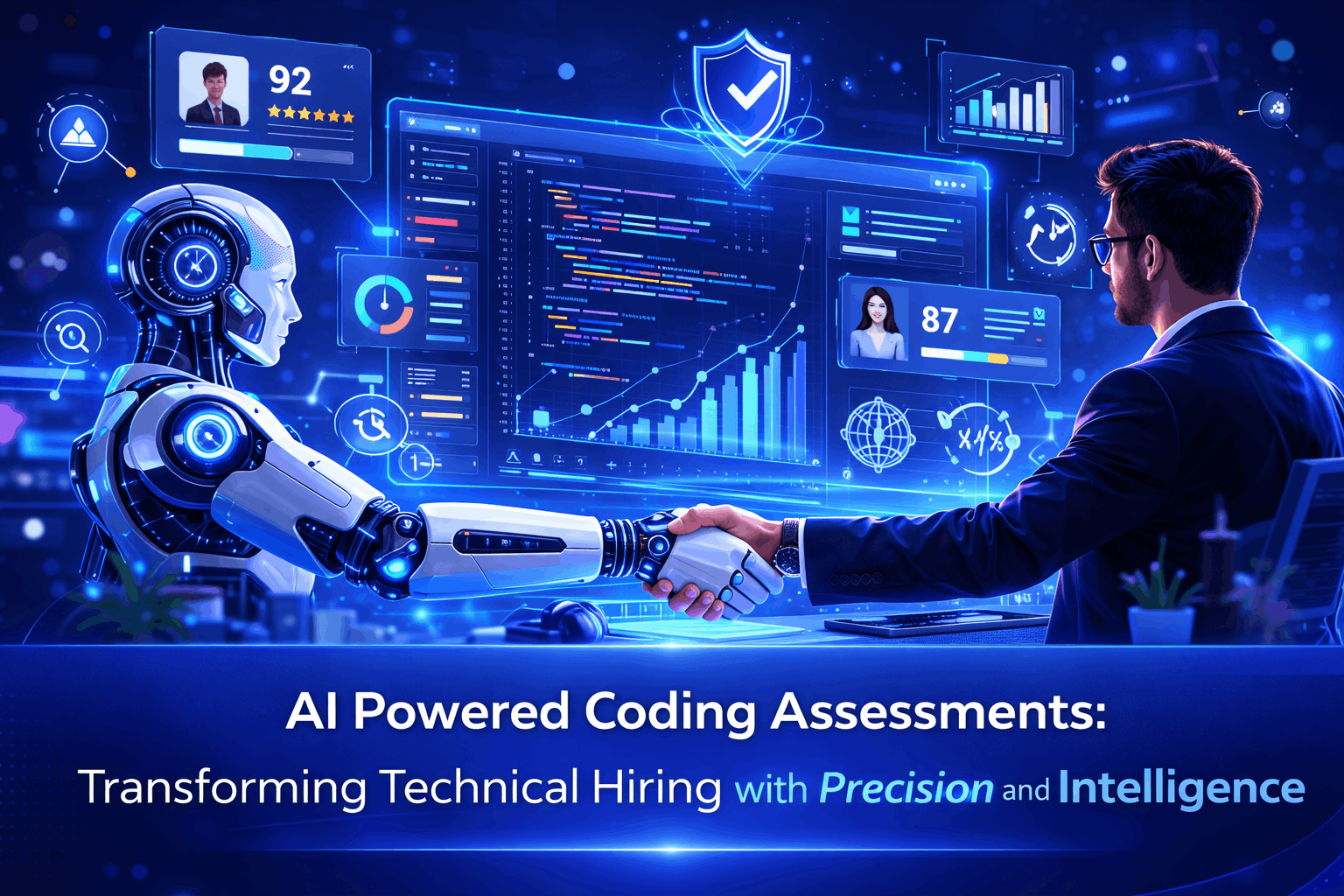
This has been a challenge that has seen progressive organizations consider smarter, quicker and more dependable solutions.
The Problem with Traditional Hiring Methods
Over the decades, recruiters and hiring managers have been using resumes, face-to-face interviews, and the gut check to assess the candidates. Although these methods have been embraced well, they are limited in various ways.
To begin with, not all resumes reflect the actual talents. Applicants can inflate their experience or add technologies that they do not know. This leaves a discrepancy between the perceived and actual ability.
Second, it is time consuming and inconsistent in manual interview process. The assessment of the candidates by different interviewers can be biased, as they can make different decisions based on the interviewer. Besides, it makes technical interviews on a large scale logistically difficult.
Unconscious prejudice is another significant problem. Human assessors are likely to make unconscious preferences towards some candidates due to their background, education or the way they communicate with each other as opposed to technical competence.
Lastly, conventional screening procedures are time-consuming. Manual tasks of sifting hundreds of applications, scheduling interviews, and evaluating candidates can make time to hire a lot more costly. This slowness can easily cost them the best talent to their rivals in a rapidly changing technology sector.
The Rise of AI Powered Coding Assessment Platforms
Organizations are now resorting to AI Powered Coding Assessments systems to overcome these challenges. Those platforms are based on artificial intelligence to analyse coding skills with speed, accuracy, and consistency.
It is in contrast to conventional approaches where AI Powered Coding Assessments are concerned with actual performance. This is done by administering candidates to practical coding tests that emulate real job activities. This code of their solutions is then analysed with intelligent algorithms by the system to give data driven and objective results.
The codexpro systems are developed in such a way that the whole process of evaluation becomes simpler and more efficient as the companies can find the right talent with minimal effort.
Key Features of AI Powered Coding Assessments
Real Time Code Evaluation
Real time code evaluation is one of the strongest aspects of AI driven platforms. The system automatically examined the logic, syntax, and efficiency of the candidates as they write code. This real time feedback makes the assessment level to be precise and representative of the real performance.
In addition, real time assessment will enable recruiters to shortlist the candidates fast without taking the time to review them manually.
Automated Scoring for Objective Results
AI Powered Coding Assessments are objective by employing automated scoring systems. Every filing is graded based on a set of specified criteria, and all applicants are graded the same.
This does not only enhance fairness but also enables the hiring teams to compare the candidates on the basis of standardized measures.
Skill Based Assessments
The knowledge gained in theory is not sufficient when it comes to modern hiring. AI based platforms are based on skill based tests which evaluate real world problem solving skills.
On the primary competencies, candidates are tested on the aspects of efficiency in codes, their ability to debug and their logical thinking. This makes sure that the candidates who have been selected are job ready at the day of selection.
Role Specific Customization
There are dissimilar skills needed in different positions. The AI-based platforms enable organizations to tailor the assessments to job needs.
In the case of a frontend developer, backend engineer, or data scientist, companies can develop tests that are specific to the position. This is a focused practice that enhances quality of hires.
Anti-Cheating Mechanisms
Assessment integrity is of paramount importance. AI-driven systems have sophisticated anti cheating software like plagiarism recognition, web tracking, and behavioral data.
The features guarantee original and reliable results even when hiring is done remotely.
Real World Benefits for Organizations
Improved Hiring Accuracy
The AI powered coding assessment can increase the accuracy of hiring dramatically by paying attention to the actual performance of coding. The organizations are sure to be choosing real talents in the candidates as opposed to speculation.
Reduced Time to Hire
The process of recruitment is accelerated by automation. Since screening to evaluation, AI powered platforms minimize human work and allow making a decision faster.
Consequently, organizations are able to attract the best employees before their competitors.
Unbiased Evaluations
The use of AI gets rid of human bias because it assesses people only based on their performance. This leads to a just and non-discriminatory recruitment process, which facilitates diversification in teams.
Data Driven Decision Making
Hiring managers have access to the specifics of analytics, thus they will be able to make a decision guided by evidence instead of their intuition. This will result in improved results and teams.
Scalability for Growing Teams
AI facilitated systems can process high numbers of applicants at a single time. This renders them suitable in organizations seeking to increase their recruitment activities without interfering with the quality.
Why Businesses Must Embrace AI Driven Hiring?
The trend of changes to AI-based coding assessment is not only a tendency but a necessity. With the ever-changing technology, the need of skilled developers will continue to grow. Those companies which are based on the old forms of hiring stand the danger of becoming out-dated.
Conversely, those organizations that embrace modern assessment instruments have a competitive advantage. They are able to recruit quicker, smarter and more efficiently as well as developing high performing teams.
Besides, AI-based recruitment is also in line with digital transformation in general. It allows firms to streamline operations and save costs as well as to improve efficiency.
How Codexpro Enables Smarter Technical Hiring?
Codexpro is a full-fledged developer of that is useful in the work of contemporary organizations. Its powerful features and easy to use interface make it easier to hire employees and provide results that are accurate and reliable.
Codexpro enables recruiters and engineering leaders to make certain hiring choices, ranging from real time analysis to in-depth analytics. You need someone to hire new developers or upgrade your existing team with more skills; the platform will provide you with the tools to win.
Its automation features reduce manual workload, allowing teams to focus on strategic initiatives rather than repetitive tasks. At the same time, its scalable design ensures that it can support organizations of all sizes.
Conclusion: The Future of Technical Hiring
In a rapidly evolving tech landscape, traditional hiring methods are no longer sufficient. Organizations need smarter solutions that can accurately assess skills, reduce bias, and accelerate hiring processes.
AI powered coding assessments offer a powerful way to achieve these goals. By leveraging intelligent technology, companies can transform their hiring strategies and build stronger, more capable teams.
Now is the time to move beyond out-dated practices and embrace a data driven approach to technical hiring. Platforms like Codexpro make this transition seamless and effective.
If you are looking to improve hiring accuracy, reduce time to hire, and make better decisions, consider adopting an AI powered coding assessment platform today. The future of hiring is intelligent, efficient, and driven by real performance.
Frequently Asked Questions
1. What are the benefits of using AI powered coding assessments for technical hiring?
AI powered coding assessments help improve hiring accuracy, reduce time to hire, eliminate bias, and provide data driven insights for better decision making.
2. How do AI powered coding assessment platforms improve developer hiring accuracy?
These platforms evaluate real coding performance through practical tests and automated scoring, ensuring that candidates are selected based on actual skills rather than resumes.
3. Can AI powered coding assessments reduce recruitment time for tech companies?
Yes, automation and real time evaluation significantly speed up the screening and selection process, enabling faster hiring decisions.
4. Are AI based coding assessments suitable for remote hiring processes?
Absolutely, with built in anti-cheating mechanisms and remote monitoring features, these platforms ensure secure and reliable assessments.
5. How to choose the best AI powered coding assessment platform for hiring developers?
Look for features such as real time evaluation, customizable tests, advanced analytics, scalability, and strong security measures to ensure effective hiring outcomes.